Reel Engine
How NexusPoint Built a Pipeline That Turns Static Infographics Into 40-Second Motion Reels With Synced Voiceover
- Timeline
- 1 Week
- Services
- Automation
- Live
- Reel Engine
01 · Challenge
Instagram Reels are the highest-reach format on the platform, with 55% of views originating from non-followers. Because the algorithm prioritizes watch time, sends, and saves over likes, pushing static content or standard infographics results in near-zero traction. However, translating complex agency concepts into professional, short-form video traditionally requires a fragmented, multi-tool nightmare.
The Four Video Production Bottlenecks
Static Format Rejection: The Reels algorithm expects motion and kinetic typography. Dropping a static infographic frame into a video container causes viewers to swipe past in under 2 seconds, failing all key ranking signals.
Brittle Voiceover Sync: Manually matching audio generated in external tools with visual scenes and word-by-word captions creates a 2 to 4-hour editing loop per reel. A single script modification forces a complete timeline rebuild.
Unverified Transcription Errors: Standard automated transcription engines frequently mishear specialized technical terms (e.g., mistranscribing "Cowork" or "Claude Code"). Without an intermediary correction layer, these errors corrupt the final render.
Destructive Audio Mixing: Basic automated mixing fails to recognize the natural interior pauses within a voiceover. This causes background music to abruptly swell during minor conversational gaps, creating jarring audio artifacts.
02 · Goal
The Reel Engine: Automated Video Compilation
NexusPoint developed the Reel Engine to address these operational constraints. Built as a programmatic video pipeline inside a Remotion 4.0 framework, it automatically translates a unified script file, voiceover audio, and supporting imagery into a branded, 9:16 motion-graphics reel.
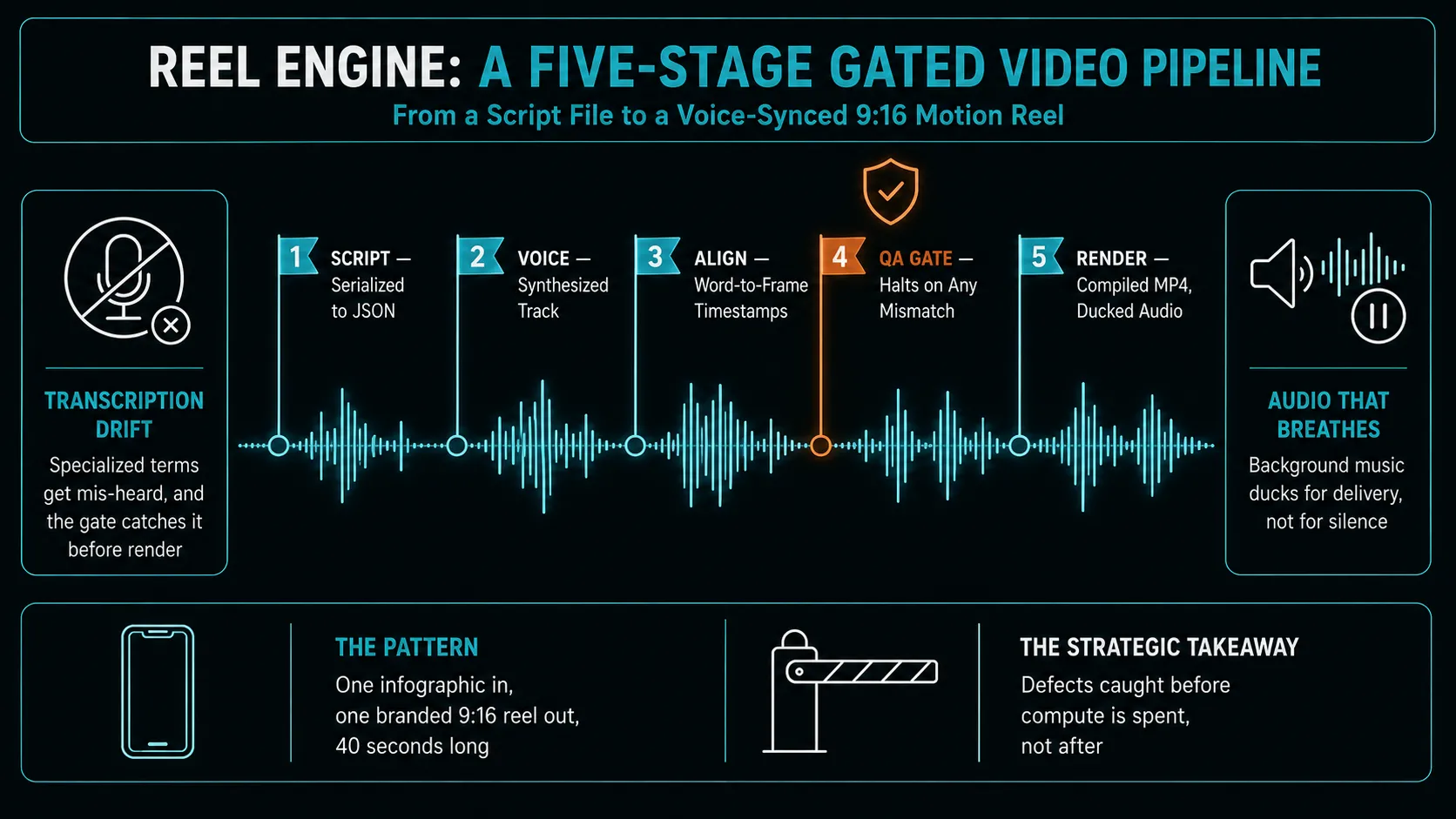
The Five-Stage Gated Pipeline
Script Serialization: Generates a structured content.json file that explicitly outlines the verbal script alongside matching scene definitions.
Voice Synthesis: Automates or captures the underlying voiceover track corresponding directly to the serialized script.
Deterministic Alignment: Runs the audio through a timestamped transcription engine to map precise word-to-frame positions on the timeline.
Ground-Truth QA Gate: Halts execution for an automated validation check. It cross-references transcription outputs against the original content.json source text, instantly correcting transcription errors before spinning up expensive compute resources.
Programmatic Rendering: Compiles the final MP4 via Remotion while simultaneously deploying an intelligent FFmpeg audio mixer to gracefully duck background tracks during vocal delivery and interior silence gaps.
03 · Result
The Reel Engine moves short-form video production from a creative bottleneck into a predictable software pipeline. By establishing an automated verification layer prior to compilation, it removes the risk of video defects and eliminates hours of manual timeline tweaking.
This architecture provides a scalable blueprint for educational content creators, product teams building automated feature walkthroughs, and marketing agencies managing high-volume social calendars. It allows teams to easily systematically transform static asset libraries into highly engaging, platform-native motion graphics for minimal cost.